What is proven
The workflow has its ingredients.
Ontology, stakeholder interviews, and ROI discovery are enough to move from discovery into a production decision.
Decision memo · June 19, 2026
The discovery motion is proven. What is unresolved is where the production version lives — because the surface we choose sets how much security and trust hardening stands between us and a real customer.
Process Discovery is no longer blocked by whether the idea makes sense. It is blocked by productionizing the stakeholder interview and evidence loop — and the surface that loop runs on is what sets the cost.
Ontology, stakeholder interviews, and ROI discovery are enough to move from discovery into a production decision.
Emails must send, replies must land and be attributed, and process maps must update from that evidence — at customer reliability.
Auth, data isolation, audit, approval gates, and compliance all follow from where this lands — and that tax, not the feature, sets the timeline.
This flips the usual intuition that the most-built option is the fastest. The feature is the cheap part, and it is the same everywhere. The expensive, variable part is the security and trust hardening — and that is the entire decision.
Read it left to right: everything left of the dashed line — the Process Discovery feature — is identical on every path. The only thing that grows is the tax to make customer data safe on that surface, and that tax, not the feature, is what separates a two-month build from a five-month one.
The recommendation is Beam. The path diagram shows how the pieces sequence; the scorecard shows why, criterion by criterion. The rows are about trust, safety, and fit — the build speed itself is shared, as the chart above shows.
| Decision criterion | Standalone wedgeAllow — wedge only | Beam platformRecommended | PrismAvoid as product |
|---|---|---|---|
| Best use | Fast pilot wedge | Production product home | Internal discovery & handoff |
| Security & trust tax on top | Pilot-only controls | Inherited — already paid | +2–3 months to build from scratch |
| Time to production-ready MVP | ~1–1.5 months | ~2 months | ~4–5 months |
| Customer trust & data isolation (today) | Not built — pilot only | Tenant-isolated at the API; audit & SOC 2 posture inherited | None — local data, no RLS, no SOC 2 |
| Fit with customers & sales story | New app to introduce; weak as a story | Customers already work here; one platform story | New product to stand up; weak as a story |
| Verdict | Use only to accelerate validation | Recommended | Do not use as production path |
The numbers are in the scorecard above. This is the one-paragraph read on what each path actually is, and the role it should play.
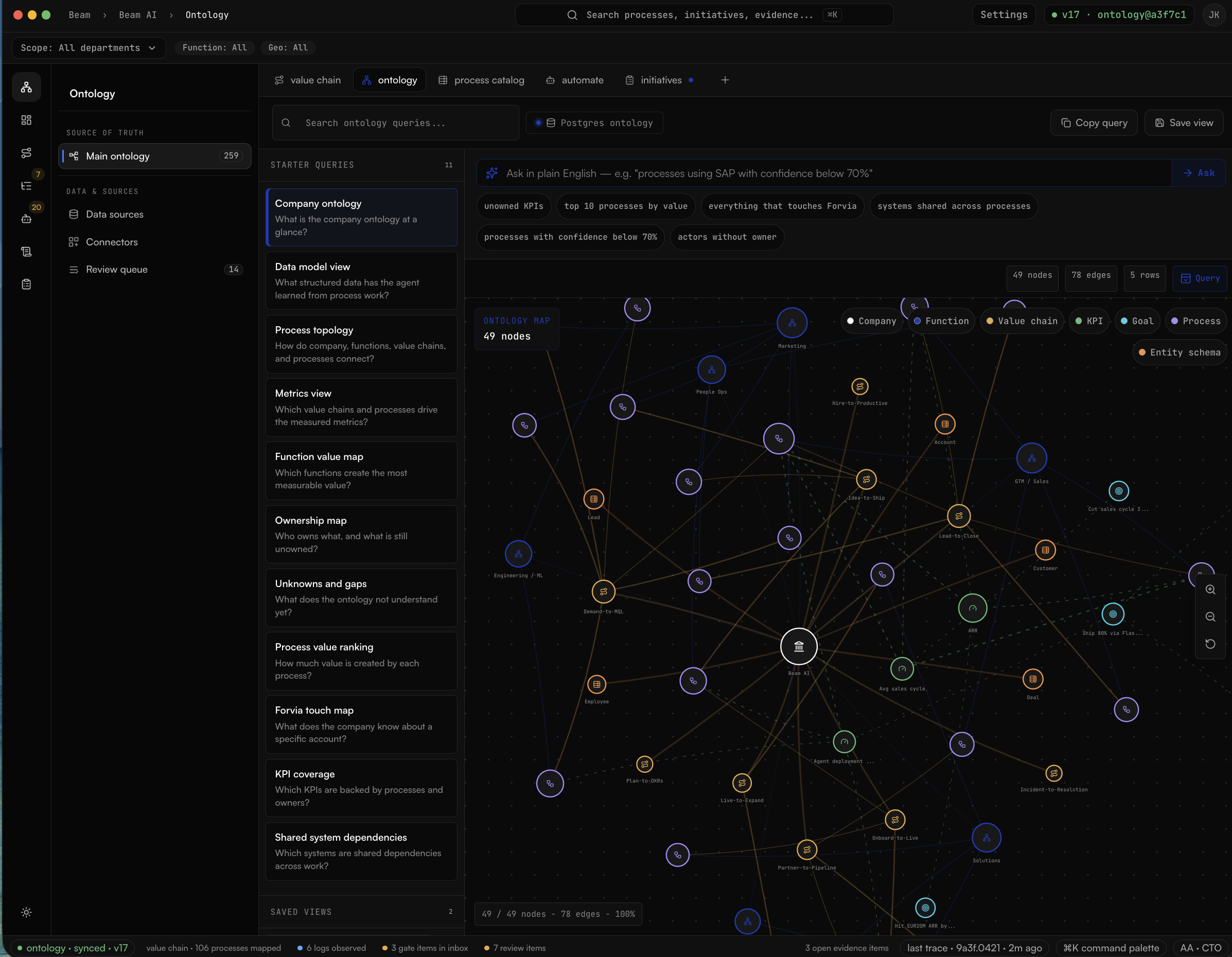
The fastest way to a live customer signal, bought by staying narrow. It skips the security and trust tax entirely — which is exactly why it cannot hold real customer data for long.
Best used as: a parallel accelerator to Beam, not a fork in the roadmap. Push outputs into Beam the moment the API contract exists.
 ⤢ Click to enlarge
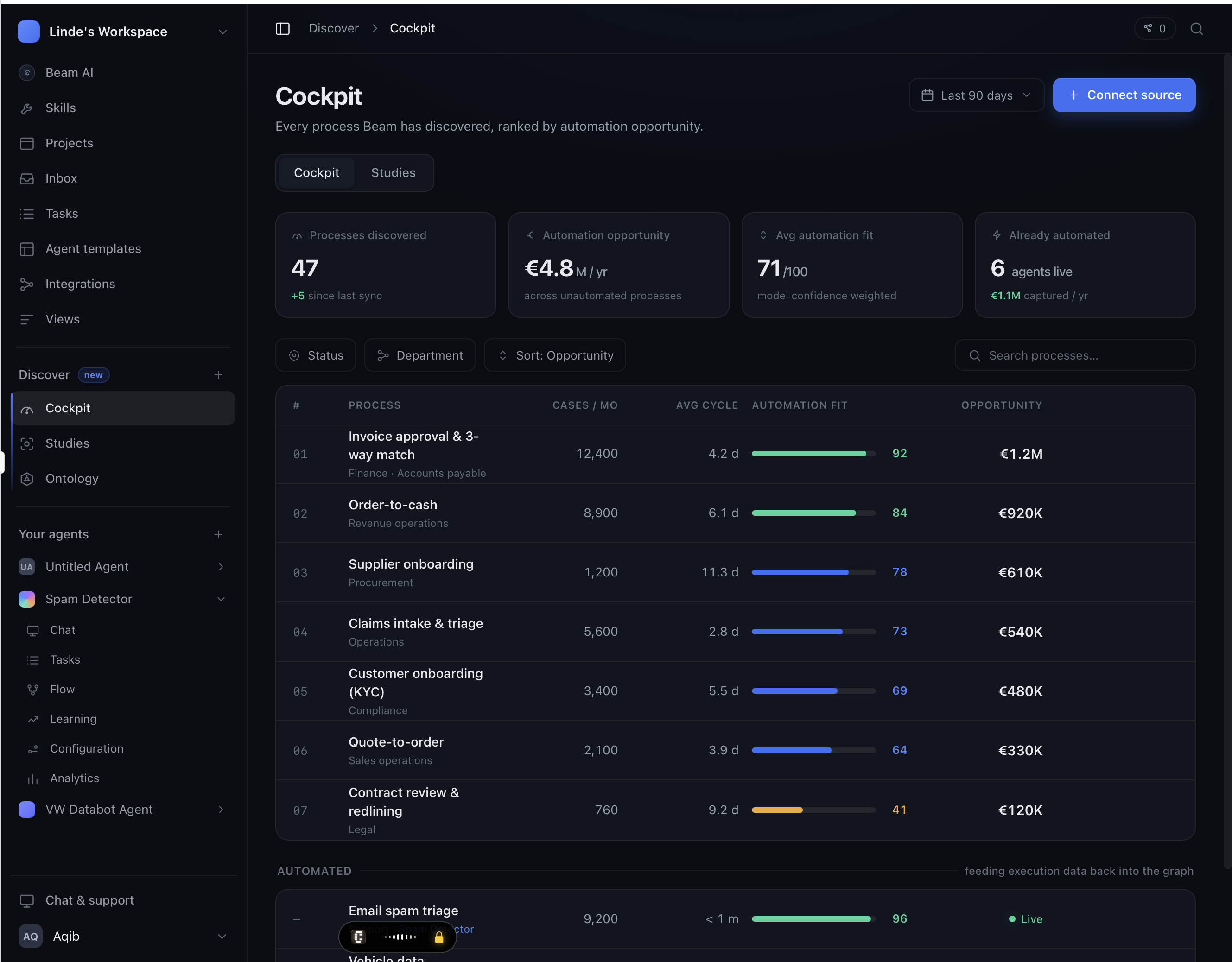
Build directly where customers already authenticate, run agents, review outputs, and trust the workspace. The trust tax is already paid — multi-tenancy, audit, approval gates, and encryption are live today — so the six-week feature is nearly all that is left.
Best used as: the production system of record. Process Discovery ends in Beam anyway — map to ROI case to agent spec — so the output lives where the next action happens.
 ⤢ Click to enlarge
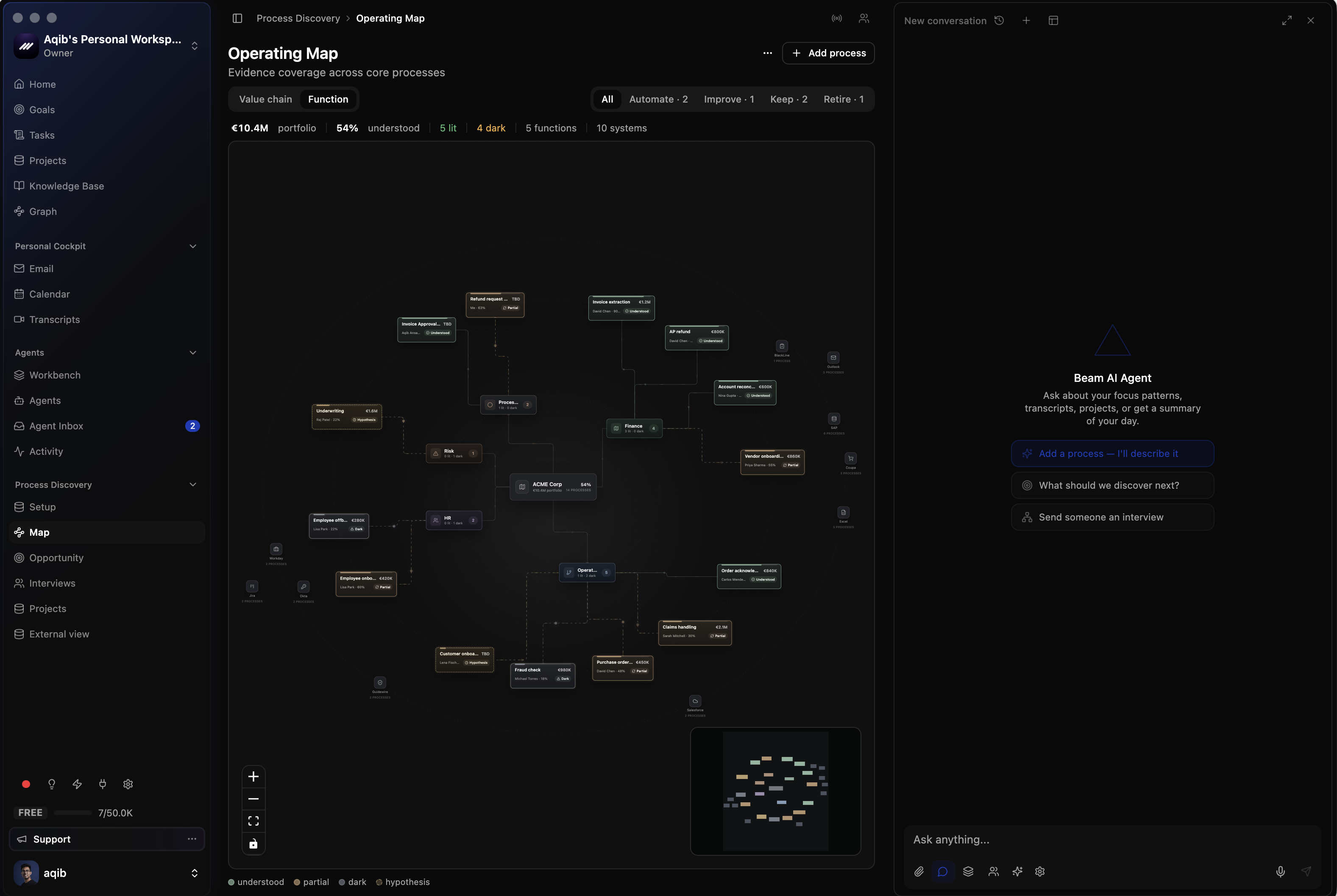
The feature is not harder to build here. The problem is that Prism is a single-user desktop app today, so going customer-facing means productionizing Prism itself first — a desktop-to-SaaS shift, with every security and trust control built from scratch.
Best used as: the internal discovery and handoff workbench that feeds Beam — genuinely useful, just not the customer runtime.
 ⤢ Click to enlarge
The hardening — per-customer isolation, audit trails, approval gates, encryption, compliance — is not optional polish, and skipping it does not save the time. It relocates the cost to the worst possible moment: a customer incident.
Skipping looks cheaper for a long time. That is the trap: the cost does not disappear, it compounds in the dark and surfaces as a breach or a failed enterprise review — exactly when it is most expensive and least recoverable.
Without per-customer isolation, an immutable audit trail, encryption-at-rest, and approval gates on outbound email, sensitive process evidence and stakeholder quotes are exposed to cross-tenant leakage, unreviewed external messages, and untraceable actions. On a surface that has not paid the trust tax, that is exactly the gap a breach walks through.
Regulated buyers in banking and insurance ask for the audit trail, data residency, and SOC 2 posture before they move past POC. No hardening means no enterprise deal — and a single breach with a design partner erases the credibility the whole discovery motion depends on. Trust is the product here.
Beam already carries most of this hardening; Prism would have to build all of it under deadline pressure. "Just ship it in Prism" quietly means "ship the trust risk too" — and that is the one thing in this motion you cannot rebuild after it breaks.
This is a single call, not a list: which surface do we productionize Process Discovery on? Pilot scope, owners, and the success metric all follow from that one choice.
Use the standalone app only as a short pilot wedge if we need a faster signal, and keep Prism as the internal discovery workbench. Everything else — pilot scope, owners, the success metric — is execution that follows this one decision.